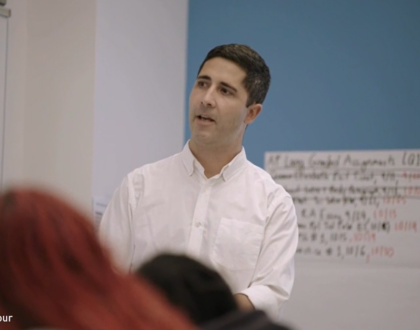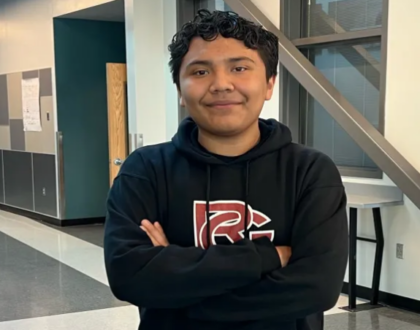
KIPP is featured as part of an ongoing series, "What Works," which highlights programs that are helping communities across the country. NBC gave video cameras to two KIPP students, one in New York and one in Los Angeles, so they could film a "day in the life of a KIPPster."
>
A cheery yellow building in southwest Houston may not look like the centre of an educational revolution, but appearances can be deceptive.
>
"I’m going to college!" she said, virtually singing. "I’m going to college!" I met Shanequa High some years ago when she was a sixth-grader at a middle school that was still in the embryonic stage (there were only two grades) in rural Gaston, N.C. The Gaston College Preparatory School was part of the KIPP network of charter schools, and the early word was that it was showing great promise.
>
I've been invited [to Newark] by KIPP (the Knowledge Is Power Programme"), the biggest and best known of America's charter school chains, which has three schools in Newark, with a fourth to open this autumn.
>
...The Bill & Melinda Gates Foundation will make $30 million in bond guarantees to high-performing charter schools in Houston. It is part of a new two-year, $400 million push in so-called program-related investments, which can consist of direct loans, equity investments, bond guarantees and other non-traditional forms of financial support. The first bond guarantees are going to the Knowledge Is Power Program, or KIPP, to help its schools in Houston secure funding in tax-exempt bonds...It is the first time a private foundation has backed charter school facility bonds at this scale.
>
...KIPP's unlikely rise is the subject of Work Hard. Be Nice. ($14.95, Algonquin Books), a new book by Washington Post education columnist and longtime reporter Jay Mathews. He spent two years visiting 31 KIPP schools and interviewing its two founders, Dave Levin and Mike Feinberg, as well as the parents, teachers and thinkers who influenced them.
>
One hot summer day in 2001, Susan Schaeffler, a 30-year-old D.C. teacher, was in the basement of an Anacostia church, getting blisters assembling classroom furniture while explaining to me why her new public charter school would be different from other ill-fated educational experiments. She said the first class of students recruited for the KIPP DC: KEY Academy middle school would not be called fifth graders, but the class of 2009.
>
...At KIPP, we believe that "the actual proves the possible." Barack Obama's election embodies this credo. As Obama and Education Secretary-designate Arne Duncan begin to shape the policies that will drive the new administration, we would like to offer five concrete thoughts from the field on how to channel Obama's "yes, we can" spirit into substantive education reform.
>
...But consider Team Academy, a charter public school in Newark, N.J. The school, set amidst some mean streets in the inner city, is a KIPP (Knowledge Is Power Program) school, which means it has just two rules: Work Hard. Be Nice.
>
Mike Feinberg and Dave Levin are co-founders of the Knowledge Is Power Program, a network of high-achieving, publicly financed but independently run charter schools that serves mostly low-income minority children in 19 states and Washington, D.C.
>
As the founder of Teach for America, a nonprofit program that recruits elite college graduates to teach in low-income schools, Wendy Kopp has presided over many triumphs, and the group's annual dinner last month was another. It raised $5.5 million in one night and brought so many corporate executives to the Waldorf-Astoria Hotel in New York that stretch limousines jammed Park Avenue for blocks.
>
Educators argue often whether their work should be judged by test scores. There are thoughtful people on both sides of the debate. We journalists tend to focus on exam results because so many of our readers say that is what they want, and such information is relatively easy to get from regular public schools.
>
Arts and education philanthropist Eli Broad today will announce his largest investment to date in Los Angeles charter schools, $23.3 million to jump-start at least 17 new campuses run by two major charter-school organizations.
>
In the hurricane's aftermath, a charter school in New Orleans defies the odds and thrives.
>
Can teaching poor children to act more like middle-class children help close the education gap?
>
Laura Bowen wants to create the best elementary school in the District. That doesn't seem very realistic, considering that she is only 28 and that the public school will be located in one of the city's poorest neighborhoods. But the KIPP charter school instructor has had success teaching low-income middle school children in Washington, and she saw something at a new school in Houston recently that convinced her the project is not as nutty as it might sound.
>
...if these two Ivy League-educated white guys had really understood the challenges of teaching fifth graders in inner-city Houston when they started out 14 years ago, they might never have had the audacity to found the Knowledge Is Power Program, a national network of public schools that has posted stunning achievement gains and shattered all manner of myths about the academic capabilities of minority kids.
>
Twenty-seven KIPP charter middle schools, including one in the District, have posted "large and significant gains" beyond what is average for urban schools, according to a report by the Educational Policy Institute.
>
When asked by Forbes's Carnahan about what makes KIPP work, KIPP Co-Founder Mike Feinberg explains: "The premise is there are no shortcuts."
>
Oklahoma City native Tracy McDaniel founded KIPP Reach College Prep in 2002 because, "he wanted to make a difference for children in his community." University of Texas Professor Darwin Winick tells People magazine, "KIPP schools use their time well."
>
The first thing you notice about the school is how quiet it is. The kids are absorbed in their studies and except for the low roar of conversation in the cafeteria during lunch, or the enthusiastic screeching of band practice, you hardly hear a sound.
>
Touring a branch of the Knowledge Is Power Program in southwest Houston is like dropping into an underage executive boot camp. The building houses three KIPP charter schools spanning pre-kindergarten to 12th grade-each one a showcase for motivational tactics.
>
...Feinberg and Levin started a classroom that operated nine hours a day instead of the normal seven, as well as on some Saturdays and during the summer. Within a year, the number of students performing at grade level in reading and math jumped to 90 percent from 50 percent...The Obama administration cites the Knowledge Is Power Program as a model of the kind of education reform it hopes to spawn with $100 billion in stimulus money.
>